 The Garden · Ardales
Join the weekend
Reconnect to Nature
The land
Five and a half hectares of old olive grove on a slope above the Río Turón, near Ardales. This is where The Garden takes root.
Regeneration
Growing something together
We want this grove to become a living food forest, step by step: water held in the land, soil covered and fed, olives growing alongside fruit trees, herbs and shade. Not all at once, and not alone, but together with the people who come here.
The area
A sun-facing slope above the river
The land is called Solana Harinal: solana is the slope that faces the sun. It looks east over the valley of the Río Turón, which runs for about 450 metres along our boundary, lined with a band of green: shrubs, reeds and trees along the water.
People have lived in this landscape for a very long time: the Cueva de Ardales holds some of the oldest cave paintings in Europe, and the ruins of Turón Castle still watch over the valley.
Around us
10 min
by car to Ardales, a picturesque white village
West
the Sierra de las Nieves, a national park, where our river water originates
East
the turquoise reservoirs, with the cleanest inland swimming beaches in Spain, and the El Chorro gorge with the famous Caminito del Rey
South
the Sierra de Alcaparaín, and beyond it the subtropical Costa del Sol
North
the historic ruins of Turón Castle just above us, and further on the ancient megalithic dolmens of Antequera, a UNESCO World Heritage Site
Soil and wildlife
Bringing the land back to life
For years this hillside was farmed the way many olive groves are, with the ground between the trees kept bare. Bare ground dries out, washes away and feeds little life, until the soil itself dies: a one-way road to desertification. Yet it is not too late. The soil is thin and tired, but soil can be rebuilt, and the riverside and the protected sierras nearby are full of life waiting to move back in.
Cover the ground
Living plants and mulch instead of bare earth, so rain soaks in and the sun cannot bake the soil. And more trees, growing into a protective canopy of shade.
Feed the soil
Compost from our kitchen and garden, returned to the land that grew it. Living soil grows with diversity: fungal networks of mycelium, and nitrogen-fixing plants that feed the ground around them.
Slow the water
Where the slope allows, small earthworks that hold the winter rain in the hillside. A few well-placed ponds can catch water that would otherwise run off. The hillside above us gathers more rain than you would think, and that natural water can help the land regenerate.
Plant between the olives
Hedges, shrubs and fruit trees. More cover brings more insects, and more insects bring more birds. A grove of only olives is fragile; diversity makes the land stronger, even antifragile, better able to withstand pests, disease and heat. Over time the olive grove becomes a lush food forest.
We will record what we find on the land, season by season.
Health and happiness
“Something changes when we slow down outside.”
The cicadas in the olives, the river below, the smell of wild rosemary and thyme in the heat, the light going gold over the mountains in the evening. Working with our hands in the soil, eating what we have grown, sitting together under a tree: these are simple things, and they make people feel well.
That is the heart of reconnecting with nature here. Not a programme, but time and space to notice the land, and ourselves on it. Breathwork and yoga under the olives can be part of the day; mostly, the land itself does the work.
A kitchen garden
Growing our own food
Close to the house there is gentler ground, the best place on the land for a kitchen garden. The map below shows where it is. The climate is kind to growing: frost on only a couple of days a year, but long, hot and dry summers, so every bed is planned around shade, mulch and careful water.
We want to grow vegetables, herbs and fruit for the shared table, and learn together what thrives here. The kitchen garden is one of the first things we hope to plant with the people who join us.
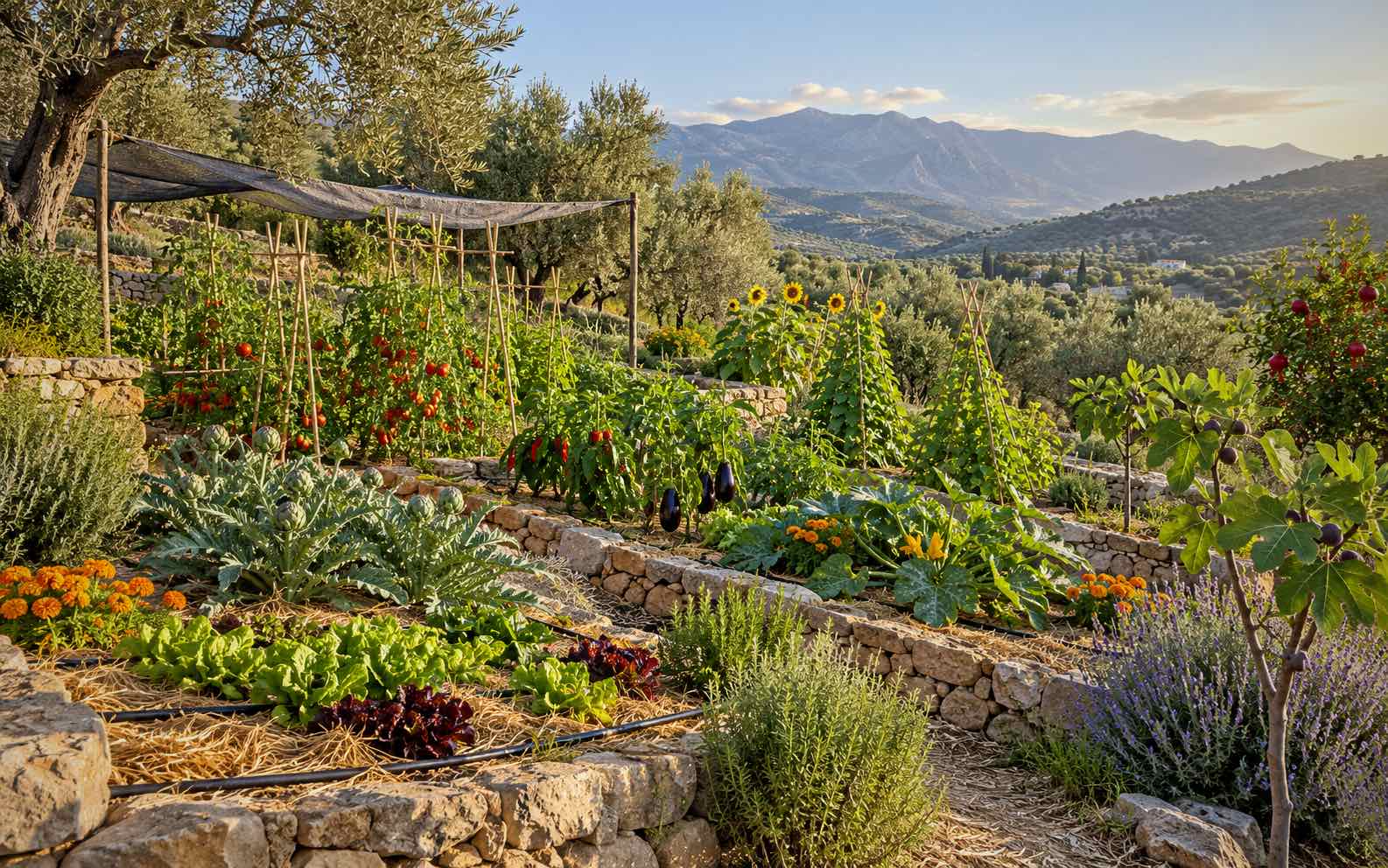
Imagined: how our kitchen garden could look.
Explore the land
An interactive map
Choose a story along the top, drag to turn the land, and tap the ground to read it.
27–29 November 2026
Come and walk the land with us
The best way to get to know the land is to be here: to walk it, sit by the river and imagine what we could grow together. The next co-creation weekend is the place to start.
About the weekend